Published September 29, 2026
How to track deep work without mistaking hours for progress
Time spent is useful evidence. It is not the same thing as moving the work that matters.
I build a tool that records work, so I have spent a lot of time thinking about what the record can actually tell me. It can tell me that I sat down for two hours, started a session and stayed with a task. Those are useful facts. They are also a little too easy to turn into a verdict: two hours logged, therefore two hours of progress.
I can have a week full of sessions and still leave the important document untouched. I can also spend 40 minutes deciding against a bad plan and save myself weeks of work. A timer sees the first week as the more impressive one. I am not sure I do.
That is the difficulty with trying to track deep work. The easiest thing to count is rarely the thing I most want to know.
What the hours are for
Hours answer a real question: did you make room for the work? If a project has received no time for three weeks, I do not need a sophisticated measure of progress. I need to know why it keeps losing its place to everything else.
Sessions answer a related question: did you come back? One long Monday can feel heroic and still leave the project alone for the rest of the month. A record of when you returned is useful for seeing that pattern.
Neither number tells me what changed. Counting more of them cannot fix that. I can improve an hours chart by leaving a timer running longer. I can improve a session count by splitting the same work into smaller blocks. The project does not notice either adjustment.
Changing the timer does not solve the measurement problem either. I wrote separately about when Pomodoro helps and when it interrupts deep work.
What moved?
I find it more useful to begin with a finished state. Say the objective is to get a proposal approved. "Work on proposal" is hard to inspect later. "Draft the section that explains the tradeoff" gives me something I can look for when I stop.
The result does not always have to be a document. I might discover that the proposal rests on a false assumption, decide which option to reject, or find the question that needs answering before anyone can approve it. That can be real progress. The point is to be able to say what changed without using the time spent as the answer.
This is why I prefer a bounded task to a 50-hour container called "proposal." I wrote about that distinction in how to define a task. A task with a visible end leaves a better record without asking me to maintain another spreadsheet.
A record I can actually keep
Before I begin, I choose the objective and name the next piece of work so I can tell when it is done. Afterward, the completed task or decision is the record. If nothing moved, I leave the task open. At the end of the week, I look at what is different. I do not need a new score or a diary entry after every session.
For exploratory work, the evidence might be as small as "ruled out option A because it cannot meet the deadline." That gives the next session somewhere to start. Another hour logged against "research" would not.
The week is a better unit of judgment
One session can be misleading. Research often looks like nothing happened until a decision suddenly becomes possible. I would rather look back at the week and ask whether the objective moved at all. Did I finish something, rule something out, or make the next step clearer? Did urgent responsibilities take every available hour instead?
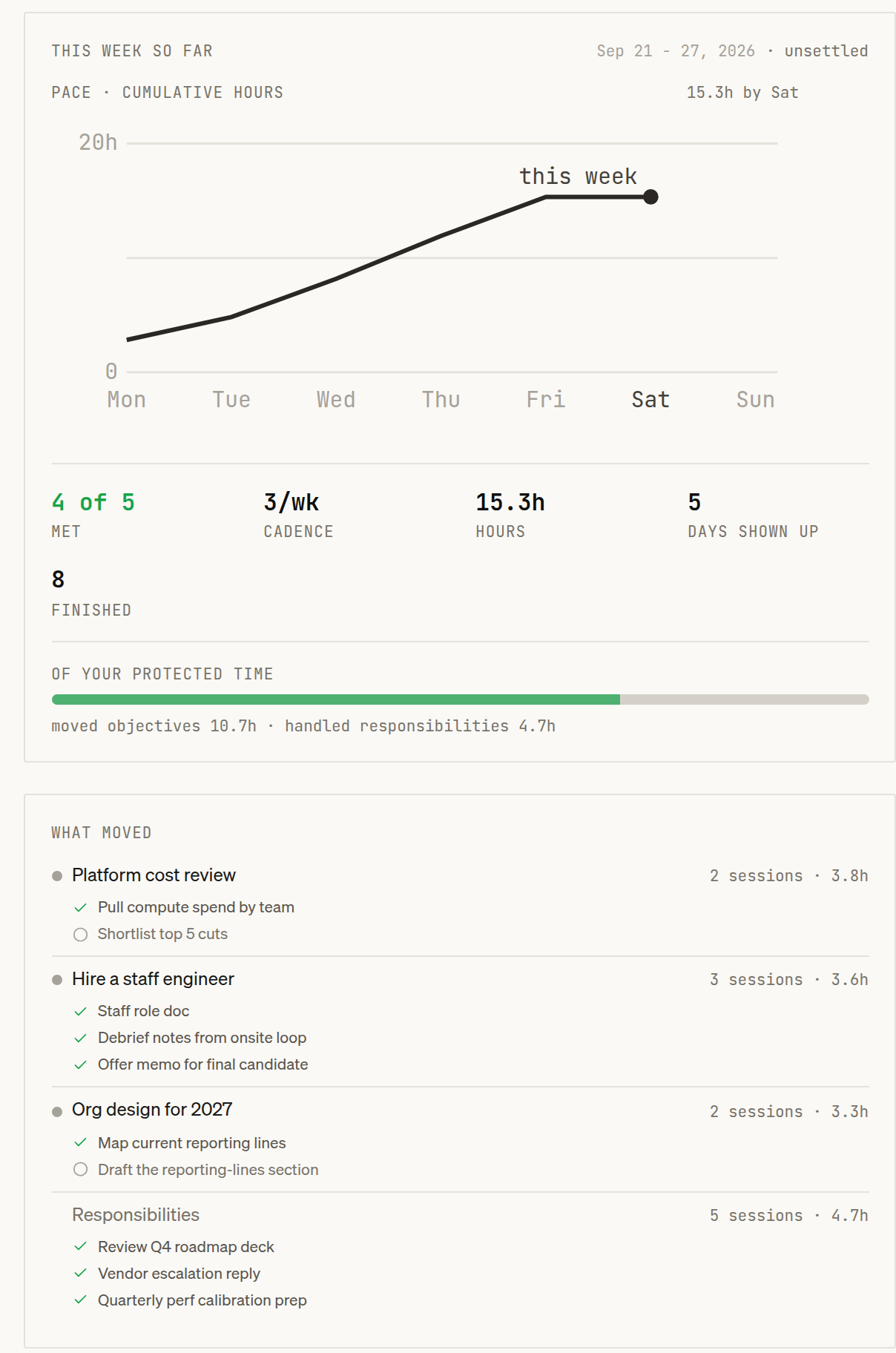
This is where a work log earns its place. The useful view puts the hours beside the commitments and the work they served. If the hours went up and the objective did not move, the record should let me see that without congratulating me for being busy.
Some objectives do have a real number outside the work log: applications sent, customers retained, a document accepted. In that case I would use the number from the place where the outcome is actually recorded. I would not turn "six sessions completed" into "60% of the objective." The percentage looks precise, but nothing about it is.
trydeepwork records the time you protected, the daily commitments you met, and how that time was divided between your objectives and other responsibilities. It gives you the week to examine. It cannot know whether the proposal was persuasive or the decision was right. I do not think a productivity tool should pretend it can.
If you want to try that kind of record, see how trydeepwork works. The hours will still be there. You will have something to read beside them.